Back to Main Tech Support Page

Ask a Question
Technical Questions
Can't find an answer in our Help Center? Submit a question, and we'll get back to you soon.
Need Business/Order Related Support?
Search our Help Center
Get answers to business and order questions from our experienced Customer Service representatives.
Website Feedback
How are we doing? We really are interested in knowing how you feel about DX Engineering. Contact us with your comments - good, bad, great, so-so, or whatever. We want to hear from you!
Hot Rodz® Adjustable Capacity Hat for Screwdriver Antennas
To see the PDF document (with pictures) Please click here: DXE-HR-2P
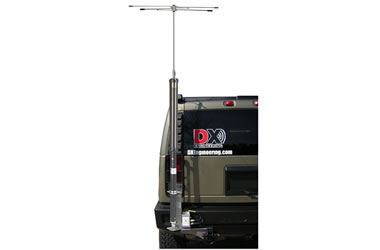
The patented* DX Engineering Hot Rodz® is an adjustable capacity hat system that increases the efficiency and gain of screwdriver antennas. Hot Rodz® achieves this, in part by enabling the use of a smaller coil, so that RF energy typically lost trough a larger coil is transferred to the antenna for a more powerful signal. A reciprocal action occurs in the receiving mode so that the received signal increases by a similar amount.
Theory of Operation
When an antenna is shortened from its natural resonant length, the feedpoint becomes capacitive. To offset the additional capacitance, it is common to add inductance in the form of a loading coil to restore the resonance. However, the additional inductor increases the resistance, which increases the loss of the antenna. Hot Rodz solve this problem by using a capacity hat - a series of horizontal rods that counters the effects of shortened vertical antennas.
A capacity hat can be thought of as an extension of the Marconi antenna design that adds horizontal elements to the design of an otherwise vertical antenna. The currents in Hot Rodz® horizontal elements offset one another and preserve the vertical polarization of the related wave.
Antenna Length and Performance
The more the antenna is shortened, the larger the coil necessary to compensate. However, the larger coil increases the resistance and consumes more power, resulting in greater loss. The loss resistance is also seen at the feedpoint and is partly responsible for making it easy to match this shortened antenna. to the 50 ohm feedline and radio. The base impedance will drop to about 16-22 ohms after the Hot Rodz® system is added.
We suggest using a mobile matcher, such as the DXE-MM-1 - Dual Impedance Transformer, to ensure your system operates at optimum efficiency.
The impedance at the feedpoint consists of the radiation resistance, coil loss and ground loss, with the radiation resistance of a full size vertical antenna equal to about 35 ohms. As the antenna is shortened, the radiation resistance decreases, but the other losses remain or even increase. To reduce the loss in a loading coil, we try to use one with the least inductance and resistance that still resonates the antenna.
Greater Efficiency at Half the Size
If the base impedance is reduced from 50 ohms total to 20 ohms total when the actual radiation resistance of the antenna is 3 ohms, then you will have more than doubled the RF power coming out of your antenna by raising its efficiency from 6% to 15%.
Half the Length on the 10-80 meter Bands
The Tarheel model 200A screwdriver antenna uses a 6-foot whip for the 10-80 meter bands (3.1 - 28.5 MHz). When combined with a Hot Rodz® system with three 12-inch rods, a 22-inch mast and a safety spring, the total of the antenna is 6-feet 11-inches, less than half the size of the standard 12-foot Tarheel. This makes an enormous difference in how often you have to get out of your vehicle to shorten the antenna.
The screwdriver antenna covers large potions of the HF spectrum with just three 24-inch rods, but antenna efficiency increases with a greater number of rods. Using more (or longer) rods is like extending the whip on a conventional antenna. The reason is that Tarheel and other screwdriver antennas are examples of the art of engineering for the mobile environment. Due to design considerations for screwdrivers, the Q (a measure of efficiency) of the coil is low - approximately 75-100 - and the smaller the coil, the better.
Hot Rodz® enable operators to use a smaller coil for any given frequency, which increases the radiated power and the feedpoint impedance. These increases result in stronger signals for transmitting and receiving.
Selecting the Frequency
The rods can be adjusted to nearly any frequency with a few simple adjustments. Follow the directions below to fine-tune your system to the desired frequency.
Lowering the Frequency
To lower the frequency of a Hot Rodz® equipped antenna, do the following until you achieve the desired results:
1. Move the rods out from the center to form a larger capacity hat.
2. Add more stainless steel rods (6 maximum).
3. Use longer rods.
4. Add a whip.
5. Extend an existing whip further in length.
Increasing the Frequency
To raise the frequency of a Hot Rodz® equipped antenna, do the following until you achieve the desired results:
1. Move the rods in toward the center to form a smaller capacity hat.
2. Add fewer stainless steel rods.
3. Use shorter rods.
4. Remove an existing whip.
5. Retract an existing whip (less length).
Matching the Modified Antenna
The base impedance of the antenna drops to about 16-22 ohms when you increase the efficiency of the antenna with the DX Engineering Hot Rodz®. In most cases, matching problems are solved wit the use of an antenna matcher such as the DXE-MM-1 -Dual Impedance Transformer.
Using the Modified Screwdriver Antenna as a Base Antenna
Hot Rodz® works for base systems as well as for mobile antennas, enabling you to operate at lower frequency bands than you might be otherwise able to do. Hot Rodz® also creates a lower profile antenna with increased efficiency so more of your RF power is transferred to the signal. A smaller antenna also improves aesthetics - replacing a 6-foot whip with a 24-inch capacity hat makes your system considerably less obtrusive.
Modifying the Screwdriver Antenna
Most screwdriver antennas are sold with a mounting bracket that can be attached between the main unit and a mounting tube of any outside diameter up to about 1.25-inch. To convert a screwdriver mobile antenna for base operations, do the following:
1. Drive a 1.25-inch OD pipe about 4 feet into the ground. Leave about 2-feet of pipe out of the ground. Note: The 1.25-inch OD is approximately the size of a 1-inch water pipe. Place a cap on the pipe to keep it from deforming while you hammer it into the ground.
2. Slip an optional DXE-RADP-3 Stainless Steel Radial Plate over the pipe and attach the radial plate to the pipe using a DXE-SSVC-2P Stainless Steel V-Clamp. Position the radial plate approximately 1-inch above the ground level to allow access to the radial wire hardware. When installing stainless steel hardware, it is suggested that UMI-81343, 81464, DXE-NSBT8, NMCT8 - Never-Seez or Anti-Seize be used to prevent thread galling.
3. Attach the radial wires to the radial plate. The radial plate comes with 20 sets of hardware, although additional hardware can be purchased to attach up to 60 radials (DXE-RADP-1HWK).
4. Use the mounting bracket from the screwdriver manufacturer to attach the antenna to the pipe.
5. Attach the coax to the radial plate by using the optional DXE-363-SST Bulkhead Fitting. Run a short section of coaxial cable to the bottom of the antenna feedpoint from the Radial Plate. Additional size rods are available, including
* US Patent #7,002,525