Back to Main Tech Support Page

Ask a Question
Technical Questions
Can't find an answer in our Help Center? Submit a question, and we'll get back to you soon.
Need Business/Order Related Support?
Search our Help Center
Get answers to business and order questions from our experienced Customer Service representatives.
Website Feedback
How are we doing? We really are interested in knowing how you feel about DX Engineering. Contact us with your comments - good, bad, great, so-so, or whatever. We want to hear from you!
Plasma TV --- Mother Of All RFI Producers
Plasma TVs produce bright, vivid color reproduction. Unfortunately, no one is mentioning the horrendous RFI that these plasma things put out on HF!
I once installed a CCTV system to keep an eye on my toys. ADT, the security company, had suggested a Panasonic 42” Plasma TV/CCTV monitor since the light output was high enough that the pix could be viewed in broad daylight.
The morning after the installation of the plasma screen, I noticed a huge digital signal about 7.001 MHz and a few other places on the same band. Next, I checked 20 meters. Then 15 meters. Same signal but a little weaker as I went up in frequency. Then, I looked at 80 meters—a gigantic noise at 3.505 MHz and other frequencies in the band. 160 meters was the same. What was this?
I did a little direction-finding and found that it was coming from my house! Sure enough when I switched off the recently installed plasma display, the noise disappeared and I could hear the DX again.
ADT talked with Panasonic, which informed them that there was nothing that could be done. I owned it. I hooked up my HP Network Analyzer to see just how bad the problem was across the HF spectrum. It was unbelievably strong!
How strong was it?
Below is a graph that shows the noise output of the plasma TV on the HP Network Analyzer. Those numbers on the right side of the graph represent db above the ambient noise level here inside the house. Yes, that would be 50 db at the top. That’s about 8 S-units!
Notice how the noise is the worst on the low bands, but the rest of the bands are impacted as well. Your new Super Duper Signal Sucker receiver will definitely find this baby on any of the HF bands!

How did I get this graph?
First, I turned the Panasonic OFF.
Then, I placed a 2m rubber ducky antenna about 10 feet from the front of the Panasonic Plasma display. I took a reading across the HF spectrum and saved it to a diskette file, which I then imported to an Excel file. This allowed me to graph the ambient noise of the area.
Next, I turned the Panasonic ON and repeated the test, again importing it to the Excel spreadsheet. After subtracting the ambient noise curve from the second curve with the screen operating, I obtained the noise produced by the screen alone.
So What?
So, you are now saying, “So what—there’s a big difference between 10 feet away and the distance between me and my closest neighbor. I might not hear that thing at all.” You are so wrong.
I have a 40m antenna that is located a quarter-mile from my house and the signal levels from the Panasonic Plasma screen were still S-3 to S-5. Plus, this is off the back of the unit where the signals are attenuated by the metal casing. The signals off the front are stronger.
I have a four-square for 40m located about 150 feet from the side of the screen and my ‘MP says it’s S9+10db. So, unless the DX is stronger than that, you’re likely to have a problem hearing them.
Let’s look at some numbers
Just one Panasonic unit produces an S-3 raspy signal on lots of frequencies at a quarter-mile away from my antenna. How many houses are within a quarter-mile radius from your house? 500? 1000? OK, now what percentage of those houses may still have one of those super efficient raspy RFI generators? Let me guess at 2%. That means that you will have 10 to 20 of these things within the quarter-mile radius of your station. Plus the prices are coming down which will result in a lot more of them. Get the picture?
The FCC will protect us, right?
This device, which is allowed to pollute the entire HF spectrum, is allegedly consistent with Part 15 rules; it says so right in the literature. It says that this device can’t cause any licensed station any interference and it has to accept all the interference from licensed devices. Now all you have to do is get the rule enforced against all those people that surround you. Good Luck.
Some of the commercial airplane manufacturers were getting ready to use these things on commercial flights. The communication systems of the “Friendly Skies” are more concerned with VHF/UHF than the HF spectrum, so it’s lucky for them that the spurious output of the screens is reduced as we go up in frequency. Even so, in order to comply with the regulations some of the screen manufacturers have had to resort to a mesh over the front of the screen to form a sort of Faraday Shield that reduces the signals. Of course, this reduces the picture quality, too. So, I didn’t expect the neighbors to start putting the mesh over their screen to help me listen for the latest weak signal.
Apparently, the manufacturers didn’t think that those of us on the ground are worth the investment in shielding, and the FCC backed them up with the limp Part 15 rules. Or maybe the Part 15 spawned the unthinking use of high voltage switching for a bright picture and RFI-be-damned attitude.
What can you do?
You could try one of the noise reduction boxes like the one made by MFJ or JPS, but my experience has been that they require a lot of fiddling and retuning every time that you change frequency.
In any case, your local Best Buy and lots of greedy electronics manufacturers who don’t mind polluting the spectrum have equipped your neighborhood with many plasma screen TV sets. This may be causing you grief without your understanding the source of your noise.
Is it true that if a device puts out a spurious signal on a certain frequency that it is susceptible to incoming signals of the same frequency? That’s just a question. I’m not advocating anything.
Paul, NO8D
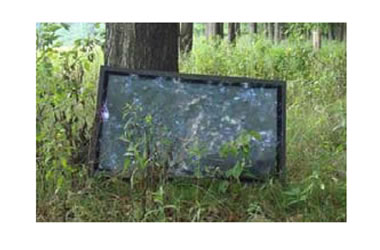
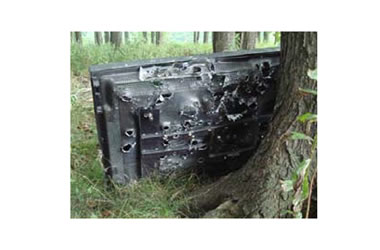
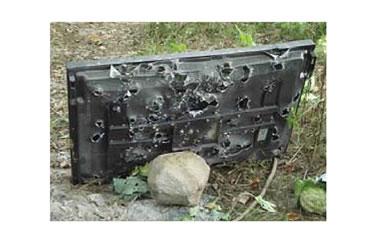
The last alternative to Plasma TVs: