Instruction Sheets for Part Number DXE-MC20-V4-1
Charts & Guides for Part Number DXE-MC20-V4-1
Part Number: DXE-MC20-V4-1
DX Engineering Maxi-Core® 20 Baluns and Feedline Chokes
Maxi-Core® 20 Voltage Balun, 4:1, 5 kW, Use on High Impedance Applications, Each
See More Specifications
Estimated Ship Date: Today Would you rather pick it up?
Overview
This is the odd balun out... the black sheep of the family. The Maxi-Core® 20 - 4:1 Voltage Balun is a 200 ohm to 50 ohm transformer, ready for use on random long-wire and Off-Center Fed (OCF) antenna applications. The DXE-MC20-V4-1 is a true voltage balun that is intentionally designed with low CMI and low RF choking, for antennas that just need a 4:1 transformer. This is the type of balun that allows for easier antenna tuner operation while tolerating modestly elevated SWR.
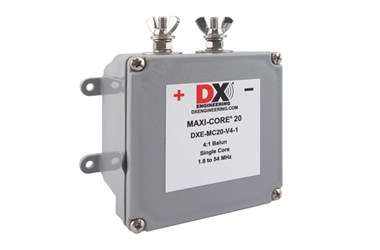
DXE-MC-V4-1 Maxi-Core® 20 - 4:1 Voltage Balun
Optional mounting brackets and plates that are also listed in the suggested parts tab include:DXE-WA-BMB for wire antennas, which allows the addition of a Coax Strain ReliefDXE-MC20K-BRKT for verticals or beam antenna mounting perpendicular to the boom for better performance
Maxi-Core® 20 Baluns feature 1/4-20 stainless steel hardware and a high quality silver-plated PTFE dielectric SO-239 (UHF female) input connector. The SO-239 connector limits power handling to 5 kW or less at low SWR and reduced power at elevated SWR. These baluns and the feedline chokes exhibit very low insertion loss and inherently low SWR. Maxi-Core ® 20 Baluns are built into a convenient weather resistant NEMA enclosure that is mounted easily with optional brackets. They have weep holes at all four corners of the “bottom” side of the enclosure, so they work properly for vertical or horizontal mounting for all types of antennas.
NOTE: Polarity markings on baluns are used for matching phase on balanced antennas when stacking beams for a phased array. Also, the positive terminal should be connected to a vertical element or Inverted-L and the negative terminal should be connected to the radial system, counterpoise, ground plane or ground. For most regular applications on a single balanced antenna, including beams, dipoles and most wire antennas, balun polarity doesn't matter.
Common mode impedance (CMI), also known as choking impedance, is a measure of how well a Balun or Feedline Choke reduces exterior RF currents traveling through it and on the outside of the coaxial cable. But high choking impedance is not the goal for this voltage balun. The voltage balun is essentially a very good transformer, and this model is well built and capable of high power operation at modestly elevated SWR.However, since this DXE-MC20-V4-1 does not suppress RF currents on the outside of the shield, a DXE-MC20-FC Feedline Current Choke should be used where the feedline approaches the ground or at the shack end of the feedline.
Years of research and testing coupled with major advancements in equipment and measurement techniques have provided the means for our engineering team to design the superior DX Engineering Maxi-Core® 20 Baluns and Feedline Chokes.
DXE-MC20-1-1 Maxi-Core® 20 - 1:1 Current Choke Balun - For all HF-6m balanced antennas with a 50 ohm feedpoint, including resonant dipoles, loops, Yagis, beams, etc.DXE-MC20-FC Maxi-Core® 20 - 1:1 Feedline Choke – This high CMI line isolator is perfect for use in line on 50 ohm coaxial feedlines, at the antenna, at the tower and at the shack end of the feedline. DXE-MC20-1-1T Maxi-Core® 20 - 1:1 Current Choke Balun – This 1:1 "T" model is for force feeding antennas with a tuner. Use it at the end of ladder line of any impedance or mounted on a coax fed non-resonant antenna. This model tolerates operation at high SWR on non-resonant multi-band antennas. Typically, for higher efficiency, this is the balun to use at the end of any impedance ladder line that is feeding a non-resonant doublet. If higher losses are acceptable, it may be mounted on a coax fed antenna. This model tolerates operation at high SWR on non-resonant multi-band antennas. But, in either case, not all frequencies are available on a single dipole, as this is a choke balun, not a tuner.DXE-MC20-C4-1 Maxi-Core® 20 - 4:1 Current Choke Balun - For use on antennas with a 200 ohm feedpoint and on any impedance ladder line, especially antenna systems with higher impedance. This model tolerates operation at high SWR on non-resonant multi-band antennas.DXE-MC20-V4-1 Maxi-Core® 20 - 4:1 Voltage Balun - A 200 ohm to 50 ohm transformer for use on random long-wire and OCF antenna applications. This true voltage balun is intentionally designed with low CMI for antennas that need a transformer without RF choking for easier antenna tuner operation. This model tolerates moderately elevated SWR.
Specifications
Documentation
Instruction Sheets for Part Number DXE-MC20-V4-1
Charts & Guides for Part Number DXE-MC20-V4-1
Some parts are not legal for use in California or other states with similar laws / regulations
Modal Header
Call To Order
This is a custom order part. You can order this part by Contacting Us.